

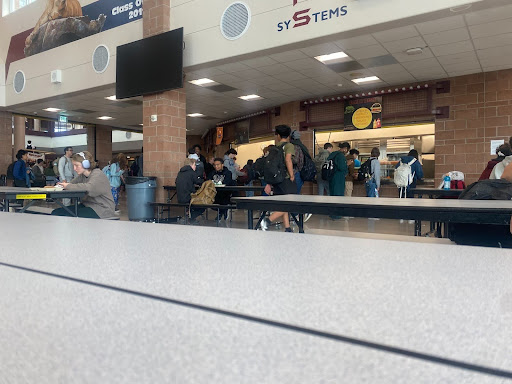
Picture this: You’re a freshman who just heard the 3rd period bell ringing. Knowing that this is your first day of high school, you rush straight to the cafeteria in order to satisfy the (small, yet noticeable) hunger that has been growing throughout the day. When you finally reach the cafeteria, realization hits: the line is long, very long.
You get to the back of the line, hoping that it’ll take just a few minutes for you to be able to grab your lunch. However, as time goes on, it’s clear that your dreams for a quick lunch line won’t come true. As you finally leave the lunch line with your food, you look at the clock and notice that you only have about 20 minutes before the lunch bell rings. With crowded tables and no time to spare, you finally find a spot and spend the few minutes you have rushing the food into your mouth before you run out of time.
It seems a common occurrence for students at CT to spend a good amount of time in the lunch line, and while some time is expected, too much can easily ruin a good lunch and leave you with little time for anything else besides eating. With this, it’s easy to ask the big question: How can one fix the lunch lines? Thinking with this question in mind, there are two options that could considerably shorten the lines for all students: enforcing student IDs and regulating the line itself.
Having students use their IDs to check out their lunch is a straightforward solution to the lunch line dilemma, but it is easier said than done. What if students forget their IDs? Are we supposed to just let them starve? Some students may also be faster at typing their ID number than scanning it, so who’s to say we should force those kids to use one method? It’s easy to see these problems when trying to enforce ID cards, but there are solutions that can help immensely.
First, the school could build an app that stores a person’s digital ID and ID number. With many students owning phones and having easy access to them, they would have a very direct, non-convoluted way to scan their IDs at the cafeteria. For students without phones, using the same method our school uses at the 8:10 bell (printing paper IDs for students who do not have their IDs) can also allow them to scan at the cafeteria.
Asking around CT, students seem to have split opinions on whether or not enforcing IDs would do anything. For example, Hung Nguyen, a junior at CT, said that “ it doesn’t help anything” when asked about the IDs. On the other side, junior Devon Curtis expressed how he believed that enforced IDs would help, feeling that “a lot of people just type the number in, or they forget it, or it takes longer to type it in and scan.” Whether enforcing IDs would be an immediate fix to the lunch lines, it’s hard to deny that it is at least a step in the right direction.
Even with IDs for every student in the school, another issue would still hinder the chance of a short lunch line: no regulation of the lunch line itself. It’s no secret that students constantly cut lines, which can inflate the line, forcing students in the back to wait longer than necessary just to eat. Aiden, a sophomore here at CT, recommended the use of a barrier, adding to how regulating the lunch lines would be “…making sure everyone’s in a straight line…no cutting…I think that would definitely help…”. Senior Maisha Ndembe also commented on enforced IDs, mentioning how “…you might not have enough time to eat their lunch. So I think it would be good to regulate.” Adding a barrier would force students to form a single-file line and make cutting not only harder but also more irritating for students in line, encouraging people to wait rather than making others mad. Having adults to also watch over the lunch lines could be a benefit when attempting to regulate them, and pairing it with a barrier could possibly eliminate the issue.
We can start fixing the lunch lines with just two easy steps, steps that would not only benefit the students at CT but also the teachers, since students will be more likely to have eaten their food and have a chance to get their energy back. It’s daunting, for sure, to enforce such dramatic changes to the lines, but it will be great for everyone (and their stomachs) overall.


